
NORMAS | TEMPLATE
Utilizamos Normas ABNT
A Associação Brasileira de Normas Técnicas – ABNT, entre outras atribuições, é responsável por padronizar a formatação de documentos técnicos, visando facilitar a sua compreensão e o acesso ao conhecimento científico.
Nesse contexto, além das normas voltadas aos trabalhos acadêmicos, a ABNT editou a Norma Brasileira NBR 6022:2018, que estabelece regras de formatação para artigos em publicação periódica técnica e/ou científica. A norma é complementada pela NBR 6023:2025 (referências), NBR 6028:2021 (resumos) e NBR 10520:2023 (citações).
Considerando que diversas faculdades no Brasil já adotam o modelo de artigo científico como trabalho de conclusão de curso, nós da Revista Tópicos também utilizamos e reunimos aqui todas as regras que devem ser observadas na formatação do seu artigo.
Após a correta formatação de seu artigo, submeta seu documento para avaliação em nosso formulário.
É imprescindível que todos os usuários leiam sobre nossa política e termos.
Fontes, margens e espaçamentos
Embora a NBR 6022:2018 não estabeleça regras sobre fontes, margens e espaçamentos, sugerimos a utilização das mesmas regras aplicadas em monografias e outros trabalhos acadêmicos:
Fonte: tamanho 12, com exceção das notas de rodapé, citações de mais de três linhas, paginação e legendas de imagens, que deverão ser de menor tamanho.
Margens: esquerda e superior de 3 cm, e direita e inferior de 2 cm.
Espaçamento: deverá ser de 1,5, com as seguintes exceções, que deverão adotar espaçamento simples:
- citações de mais de três linhas
- notas de rodapé
- referências
- legendas das ilustrações e tabelas
Estrutura Geral da Revista
| Estrutura | Elementos |
|---|---|
| Pré-textual |
|
| Textual |
|
| Pós-textual |
|
A NBR 6022:2018 estabelece que todos os elementos inseridos no artigo deverão ser estruturados na ordem demonstrada na tabela acima.
Elementos pré-textuais
Os elementos pré-textuais são aqueles apresentados antes do conteúdo do artigo e consistem no título, subtítulo (se houver), título em idioma estrangeiro, nome do(s) autor(es), resumo e palavras-chave na língua do texto, e resumo e palavras-chave em idioma estrangeiro. A Revista Tópicos exige o envio do título, resumo e palavras-chave também em inglês. Esses elementos devem ser formatados conforme o exemplo abaixo:

Diferente das monografias, os elementos pré-textuais nos artigos científicos devem estar juntos e na mesma página de abertura do conteúdo.
O resumo deverá conter de 100 a 250 palavras (NBR 6028:2021) e as palavras-chave devem ser separadas entre si por ponto e vírgula (;), encerrado por ponto final.
Atenção: a norma prevê ainda que a página de abertura deverá ter uma nota de rodapé contendo um breve currículo do autor, bem como seu endereço postal e eletrônico.
Elementos pós-textuais
Os elementos pós-textuais são apresentados após a conclusão do artigo. O único elemento obrigatório são as referências. Os demais — glossário, apêndices, anexos e agradecimentos — são opcionais.
As referências deverão seguir as normas previstas na NBR 6023:2025 e serão formatadas da seguinte forma:

As referências deverão conter as informações essenciais à identificação das fontes e, sempre que possível, informações complementares que facilitem esse reconhecimento (como DOI). Diferente das monografias, as referências em artigos científicos não precisam constar em folha exclusiva, somente após a conclusão do trabalho ou em notas de rodapé.
Observações importantes sobre referências (NBR 6023:2025):
- URLs não devem conter os sinais < >
- O espaçamento entre as referências deve ser simples
- Quando disponível, incluir o DOI da obra
- O ISSN passou a ser elemento complementar (opcional)
Elementos pós-textuais opcionais
Os elementos pós-textuais opcionais são aqueles que ficam a critério do autor e consistem no glossário, apêndices, anexos e agradecimentos.
As notas explicativas não são apresentadas após a conclusão do artigo, mas sim em notas de rodapé ao longo do texto. Elas são usadas quando o autor sentir necessidade de complementar algum ponto do artigo, seja com as suas próprias palavras ou com citações.
As notas explicativas e o glossário serão formatados da seguinte forma:

Exemplos de notas explicativas retirados da Norma Brasileira NBR 6022:2018.
Vale mencionar que a numeração das notas explicativas não reinicia a cada página, devendo seguir consecutivamente até o fim do artigo. Com relação ao glossário, este deverá ser organizado em ordem alfabética.
Já os apêndices e anexos são documentos juntados pelo autor para fundamentar, comprovar ou ilustrar o conteúdo do artigo, e devem seguir esta formatação:
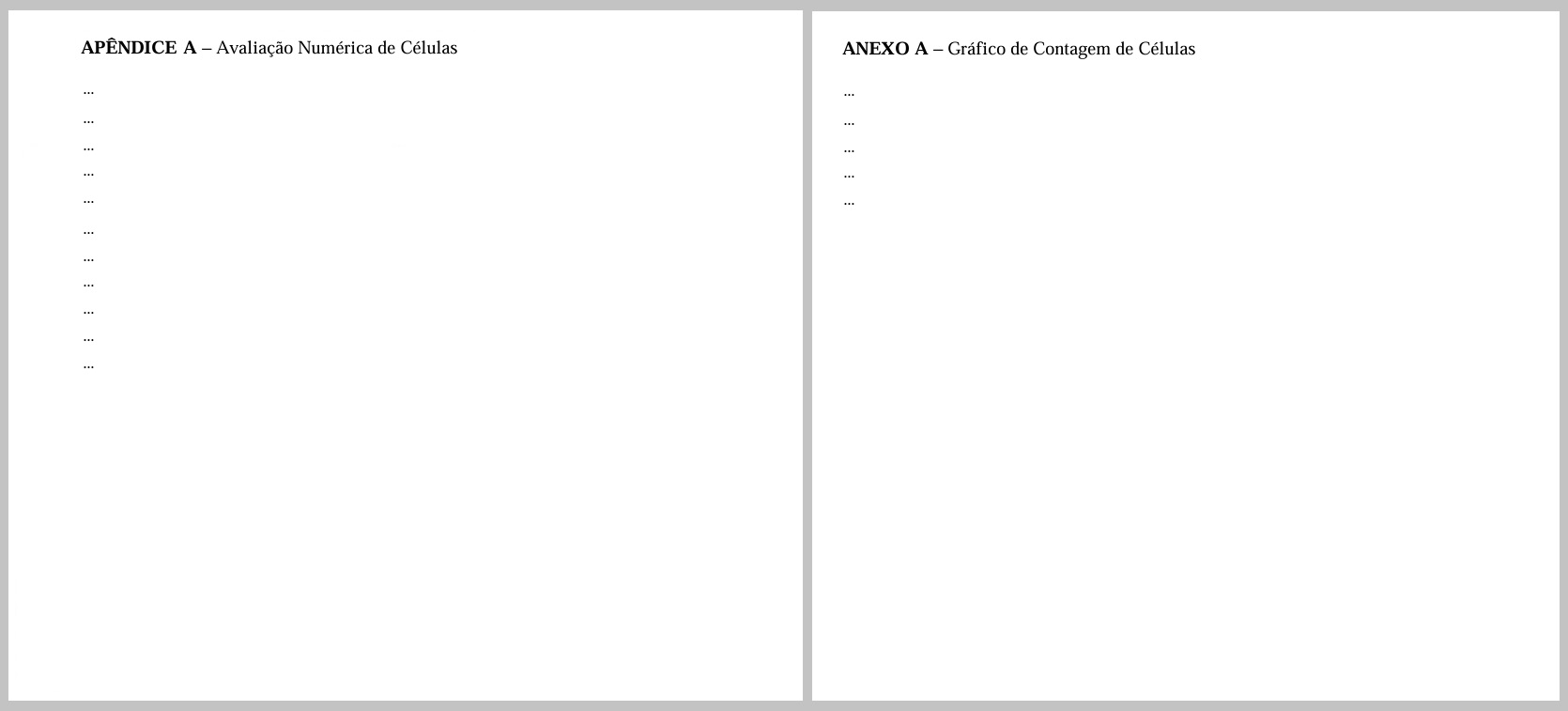
Conforme o exemplo acima, os apêndices e anexos deverão ser identificados por letras maiúsculas seguidas de travessão e a identificação do seu conteúdo.
Os agradecimentos, quando houver, deverão ser o último elemento pós-textual do artigo (NBR 6022:2018).
Citações (NBR 10520:2023)
A NBR 10520:2023 regula a forma de apresentar citações em documentos acadêmicos. Em relação à versão anterior, trouxe mudanças significativas que impactam diretamente a formatação do artigo:
- Sobrenome em caixa alta abolido: nas citações entre parênteses, o sobrenome do autor deve ter apenas a inicial maiúscula. Exemplo: (Silva, 2020) e não (SILVA, 2020).
- Separador entre autores: usa-se ponto e vírgula entre os autores nas citações entre parênteses — ex.: (Silva; Santos, 2020). No texto corrido, usa-se a conjunção "e" — ex.: Silva e Santos (2020).
- et al. em itálico: para obras com quatro ou mais autores, utiliza-se et al. em itálico — ex.: (Kingston et al., 2010).
- Ponto antes do parêntese: o ponto final da frase deve ser colocado após o fechamento do parêntese da citação.
- Citações diretas longas: recuo de 4 cm da margem esquerda é recomendado, com fonte menor e espaçamento simples, sem aspas.
Expressões latinas como apud, ibid. e et al. devem sempre aparecer em itálico.
Redação do Resumo (NBR 6028:2021)
A NBR 6028:2021 estabelece regras específicas sobre como o resumo deve ser redigido, além dos limites de extensão:
- Parágrafo único: o resumo deve ser composto por frases concisas e afirmativas, em um único parágrafo — não utilize tópicos ou marcadores.
- Voz ativa e terceira pessoa do singular: ex.: "O estudo analisa…" ou "O artigo investiga…"
- Primeira frase significativa: deve explicar o tema principal do documento de forma clara e objetiva.
- Extensão: de 100 a 250 palavras para artigos de periódicos.
- Palavras-chave: devem ser apresentadas logo abaixo do resumo, separadas entre si por ponto e vírgula (;) e finalizadas com ponto.
Publicação Digital e DOI
A NBR 6022:2018 reconhece o contexto digital como principal meio de publicação científica. Isso implica requisitos adicionais:
- DOI (Digital Object Identifier): identificador digital único e permanente do artigo. A Revista Tópicos atribui DOI a todos os artigos publicados. Quando disponível, o DOI deve constar nas referências ao citar o artigo.
- E-location: artigos publicados exclusivamente em meio digital que não possuem número de página tradicional podem ser identificados por localizadores eletrônicos (e-location).
- ISSN eletrônico: a Revista Tópicos possui ISSN 2965-6672 (publicação eletrônica). Este dado deve ser utilizado ao referenciar a revista.
English Version
We use ABNT Standards
The Brazilian Association of Technical Standards – ABNT, among other attributions, is responsible for standardizing the formatting of technical documents, aiming to facilitate their understanding and access to scientific knowledge.
In this context, in addition to the norms aimed at academic works, ABNT edited NBR 6022:2018, which establishes formatting rules for articles in technical and/or scientific periodical publications. The norm is complemented by NBR 6023:2025 (references), NBR 6028:2021 (abstracts) and NBR 10520:2023 (citations).
Considering that several colleges in Brazil already adopt the model of a scientific article as a course conclusion work, we at Revista Tópicos also use and gather here all the rules that must be observed in the formatting of your article.
Fonts, margins and spacing
Although NBR 6022:2018 does not establish rules about fonts, margins and spacing, we suggest using the same rules applied in monographs and other academic works:
Font: size 12, with the exception of footnotes, citations of more than three lines, pagination and image captions, which should be smaller.
Margins: 3 cm left and top, 2 cm right and bottom.
Spacing: should be 1.5, with the following exceptions, which should adopt single spacing:
- quotes longer than three lines
- footnotes
- references
- captions for illustrations and tables
General Structure of the Journal
| Structure | Elements |
|---|---|
| Pre-textual |
|
| Textual |
|
| Post-textual |
|
NBR 6022:2018 establishes that all elements inserted in the article must be structured in the order shown in the table above.
Pre-textual elements
The pre-textual elements are those presented before the content of the article and consist of the title, subtitle (if any), title in a foreign language, author(s) name, abstract and keywords in the language of the text, and abstract and keywords in a foreign language. Revista Tópicos requires the submission of the title, abstract and keywords also in English. These elements must be formatted according to the example below:
Unlike monographs, the pre-textual elements in scientific articles must be together and on the same opening page of the content.
The abstract should contain 100 to 250 words (NBR 6028:2021) and the keywords must be separated by semicolons (;), ending with a period.
Attention: the norm also provides that the opening page must have a footnote containing a brief curriculum of the author, as well as his postal and electronic address.
Post-textual elements
Post-textual elements are presented after the article is completed. The only mandatory element is the references. The remaining elements — glossary, appendices, attachments and acknowledgments — are optional.
References must follow the rules set forth in NBR 6023:2025 and will be formatted as follows:
The references must contain the essential information to identify the sources and, whenever possible, additional information that facilitates this recognition (such as DOI). Unlike monographs, references in scientific articles do not need to appear on an exclusive page, only after the conclusion of the work or in footnotes.
Important notes on references (NBR 6023:2025):
- URLs should not contain angle brackets < >
- Spacing between references should be single
- Include the DOI when available
- ISSN is now a complementary (optional) element
Optional post-textual elements
Optional post-textual elements are those at the discretion of the author and consist of glossary, appendices, annexes and acknowledgments.
Explanatory notes are not presented after the conclusion of the article, but in footnotes throughout the text. They are used when the author feels the need to complement some point in the article, either with his own words or with quotes.
The explanatory notes and glossary will be formatted as follows:
Examples of explanatory notes taken from Brazilian Standard NBR 6022:2018.
It is worth mentioning that the numbering of the explanatory notes does not restart on each page, but must continue consecutively until the end of the article. With regard to the glossary, it should be organized in alphabetical order.
Appendices and annexes are documents put together by the author to substantiate, prove or illustrate the content of the article, and must follow this format:
As in the example above, appendices and annexes must be identified by capital letters followed by a dash and the identification of their content.
Acknowledgments, when applicable, must be the last post-textual element of the article (NBR 6022:2018).
Citations (NBR 10520:2023)
NBR 10520:2023 governs how citations are presented in academic documents. Compared to the previous version, it introduced significant changes that directly affect article formatting:
- No more all-caps surnames: in parenthetical citations, only the first letter of the surname is capitalized. Example: (Silva, 2020), not (SILVA, 2020).
- Separator between authors: use a semicolon between authors in parenthetical citations — e.g., (Silva; Santos, 2020). In running text, use "and" — e.g., Silva and Santos (2020).
- et al. in italics: for works with four or more authors, use et al. in italics — e.g., (Kingston et al., 2010).
- Period placement: the final period must be placed after the closing parenthesis of the citation.
- Long direct quotations: a 4 cm indent from the left margin is recommended, with smaller font and single spacing, no quotation marks.
Latin expressions such as apud, ibid. and et al. must always appear in italics.
Writing the Abstract (NBR 6028:2021)
NBR 6028:2021 establishes specific rules on how the abstract must be written:
- Single paragraph: the abstract must consist of concise, affirmative sentences, in a single paragraph — do not use bullet points or numbered lists.
- Active voice, third person singular: e.g., "The study analyzes…" or "The article investigates…"
- Meaningful first sentence: it must clearly explain the main topic of the document.
- Length: 100 to 250 words for journal articles.
- Keywords: must appear immediately below the abstract, separated by semicolons (;) and ending with a period.
Digital Publishing and DOI
NBR 6022:2018 recognizes the digital context as the primary means of scientific publication. This implies additional requirements:
- DOI (Digital Object Identifier): a unique and permanent digital identifier for the article. Revista Tópicos assigns a DOI to every published article. When available, the DOI must be included in references when citing the article.
- E-location: articles published exclusively in digital format without traditional page numbers may be identified by electronic locators (e-location).
- Electronic ISSN: Revista Tópicos holds ISSN 2965-6672 (electronic publication). This data must be used when referencing the journal.